Configure in situ
Set Rg(on), Rg(off), CGE, active clamping and timings on a driver that is already fitted to the module.
Power Insight
The measurement layer inside the Amantys gate drive. It measures the semiconductor it is switching and reports over the fibre that already carries control — so a degrading module shows months before it stops, with no extra sensors in the stack.
Live from the semiconductor
unchanged since day one
steady
within limits
within limits
Module temperature, logged over 18 months at unchanged load
The technology
The gate drive does not only switch the module. It measures it — gate-emitter and collector-emitter voltage, board and module temperature, fault counts — and reports them over the same fibre that carries the PWM. Logged across operating hours, a drift in those numbers appears long before a failure does.
01
VGE, VCE, gate driver board temperature and module NTC, taken at the semiconductor rather than inferred from the cabinet.
02
Values and fault counts come back over the existing fibre-optic link, so there is no second harness and no extra isolation barrier to design.
03
Logged over time, condition drift crosses a threshold while the converter is still healthy — which turns an unplanned outage into a planned service visit.
The configurator
The Windows configurator talks to the drivers through the Power Insight Adapter. It is the reason an AP driver can be tuned for your stack rather than ordered to a fixed specification.
Set Rg(on), Rg(off), CGE, active clamping and timings on a driver that is already fitted to the module.
Read the fault counters out of the gate driver to see what the stack has been doing.
Update the firmware of both the gate drive and the Power Insight Adapter.
Capture diagnostic information from the gate drive for fault analysis.
Generate double-pulse test waveforms for the IGBT and the gate drive with no extra hardware. Tests can be saved and reloaded.
Configuration pane
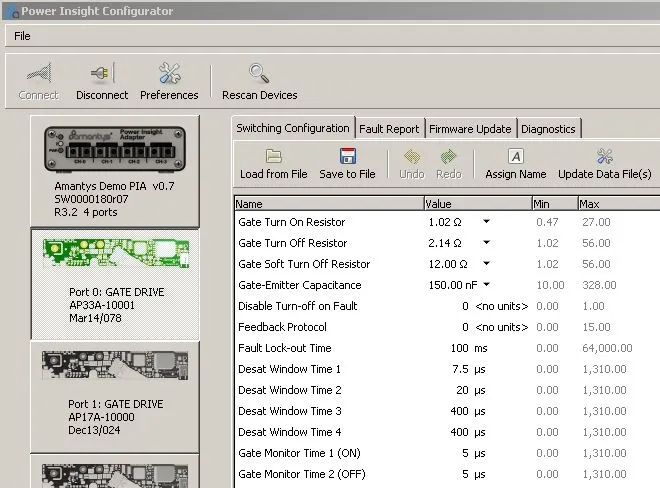
The configuration pane lists the gate drivers connected to the Power Insight Adapter with their serial numbers and IP addresses. Parameters are changed from here, per driver, while the converter runs normally.
The hardware link
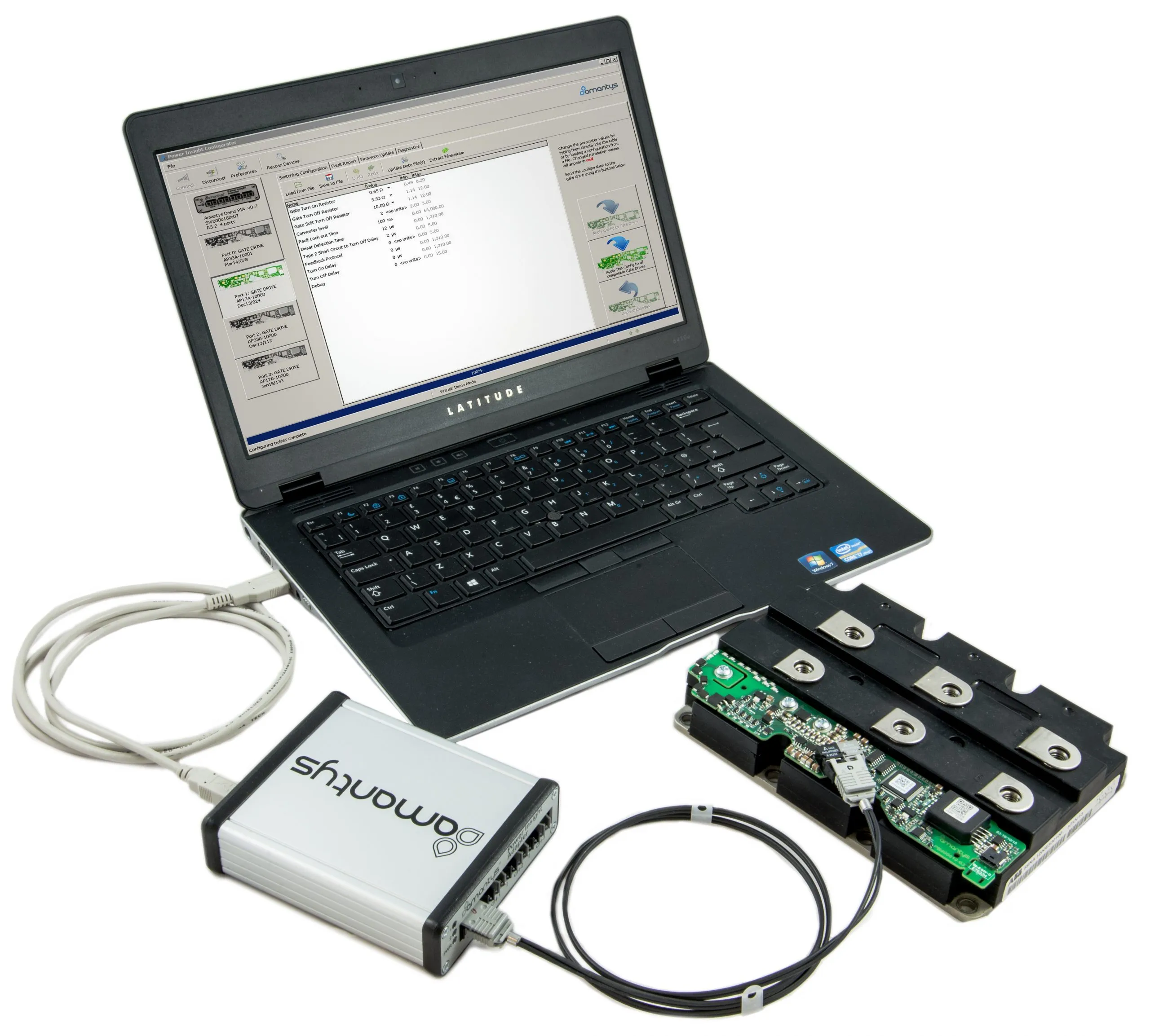
The Power Insight Adapter is the fibre-optic bridge between a Windows laptop and the drivers in the converter. It is the only extra hardware involved, and it comes off again once the work is done.
Pulse generator pane
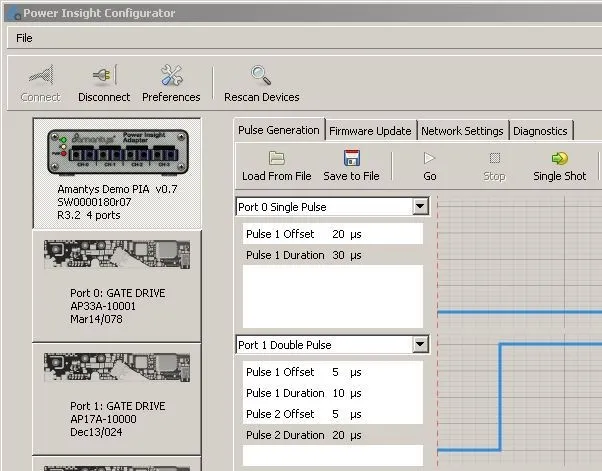
Generate double-pulse tests directly, with no additional hardware to control the gate drivers. Save a test to a file and load it again later, so characterisation is repeatable across builds.
Get in touch
Tell us the driver and the adapter you have, and we will send the current configurator build and the matching product database.